
“Why did this laptop quote jump by hundreds of dollars since last year?”
“Why does every new desktop configuration start at 16 or 32 gigabytes of RAM?”
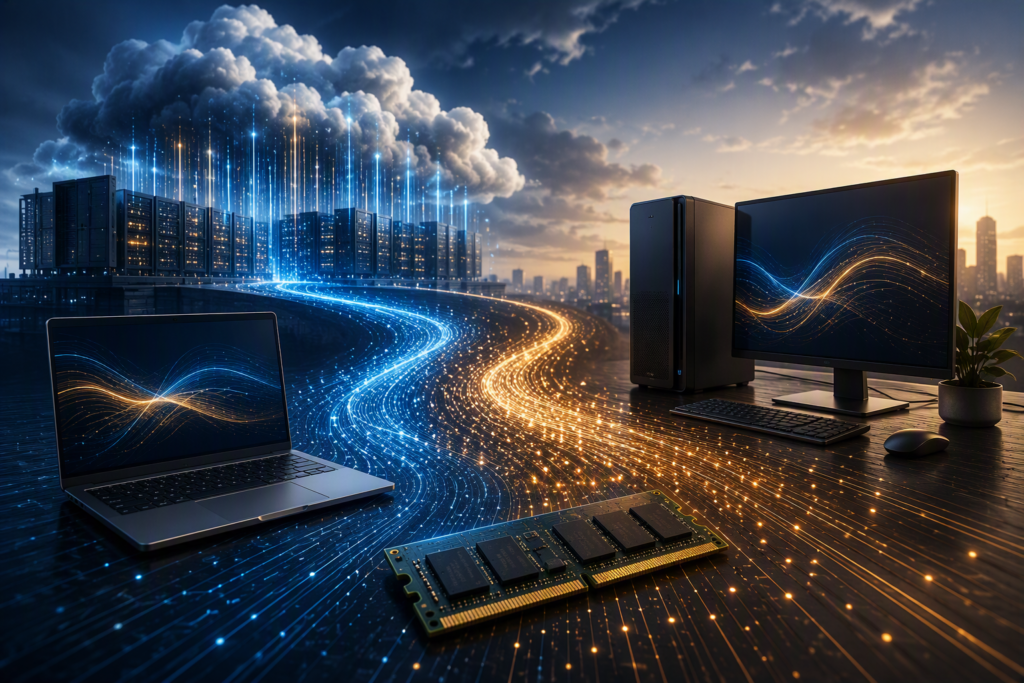
For many business leaders, PC purchasing has turned into a painful surprise. The culprit is not just inflation or “better specs.” It’s the ripple effect of artificial intelligence, cloud-scale datacenters, and a memory market being pulled in two directions at once.
Behind every AI assistant, recommendation engine, and cloud analytics platform sit massive datacenters that consume enormous amounts of DRAM. Those same DRAM factories also supply the memory chips inside your employees’ PCs. As hyperscale buyers race to feed AI demand, the rest of the market lives with higher prices, tighter supply, and rising “minimum” configurations.
This article explains why AI is driving a DRAMa-filled market, how that flows directly into what you pay for PCs, and how practical infrastructure strategy gives you a way to stay ahead of the curve instead of getting trapped by it.
How AI Datacenters Broke the Old PC Pricing Model
For years, PC memory pricing followed a familiar cycle. New generations of DRAM launched at a premium, prices settled as volume increased, then eventually dipped before the next upgrade wave. That model assumed a relatively stable split between server and client demand. AI has changed that.
AI Models Are Memory Monsters
Training and running large AI models is resource intensive. It’s not only about GPUs and specialized accelerators. These systems also require:
- Very large pools of DRAM per server
- High-bandwidth memory on accelerators plus conventional DRAM for surrounding infrastructure
- Additional in-memory caching and search layers for vector databases and analytics
Hyperscale providers and large enterprises are now buying server memory in quantities that dwarf traditional corporate data center consumption. DRAM manufacturers respond by prioritizing high-margin datacenter parts and next-generation technologies tuned for AI throughput.
Same Fabs, Different Customers
Those same memory fabs produce the chips that go into business laptops and desktops. When AI datacenter demand spikes, manufacturers:
- Allocate capacity toward high-margin server and HBM products
- Slow or tighten supply for commodity PC DRAM
- Focus roadmaps around bandwidth and capacity, not low-cost client SKUs
The result is a structural shift. PC memory is no longer the primary volume product that sets the pace. It’s a secondary consumer riding on the coattails of AI and cloud requirements.
Software Quietly Raises the Floor
At the same time, operating systems and everyday applications assume more memory is available. For example:
- Modern Windows builds and productivity suites are optimized for 16 gigabytes and higher
- Browsers with many tabs, conferencing tools, and always-on security agents are now normal
- Local AI features, such as document summarization or meeting transcription, cache and process more data in memory
What used to be a “premium” configuration now feels like the minimum for a productive knowledge worker. When you combine a higher technical baseline with a DRAM market tilted toward datacenters, PC quotes rise quickly.
Where You Will Feel The DRAMa In Your Business
AI-driven memory demand shows up in several practical ways for small and mid-sized organizations.
Higher entry price for “standard” PCs
- Eight gigabytes is no longer a safe default for most roles
- Vendors lead with 16 or 32 gigabyte configurations at higher price points
- Bargain configurations struggle with performance and user satisfaction
Shorter useful lifecycle for older hardware
- Systems that were adequate three or four years ago feel constrained today
- Local AI features, modern browsers, and security tools push them past their limits
- Extending life by upgrading RAM is harder or less cost-effective on older platforms
Server and VDI projects cost more than expected
- Memory-dense virtualization hosts and VDI stacks compete directly with AI workloads for supply
- Capacity planning underestimates real-world RAM needs, leading to surprise budget expansions
Cloud bills quietly inflate
- In the cloud, you usually buy CPU and memory together
- As workloads need more RAM, you move to larger instance sizes and pay more overall
- AI services layered on top often increase the memory footprint again
You can’t stop AI from transforming the memory market. You can decide whether your response is reactive and ad hoc, or guided by a data-driven infrastructure strategy.
Designing Infrastructure For a High-Cost Memory World
Cloud Infrastructure Management: Controlling Hidden Memory Costs
Cloud Infrastructure Management services ensure that your cloud environments are optimized, secure, and tailored to your needs. From a memory cost perspective, that includes:
- Right-sizing instances based on actual RAM utilization, not vendor defaults
- Separating memory-hungry workloads from lighter services, so you don’t oversize everything
- Monitoring trends and adjusting resource allocations before costs spiral
This is critical when AI features creep into applications and push instance sizes up. Without disciplined management, you pay AI prices for workloads that don’t truly need them.
Hybrid Cloud Solutions: Putting the Right Workload in the Right Place
Hybrid Cloud Solutions help you integrate on-premises infrastructure with the cloud. In a DRAMa-filled market, that lets you keep predictable, memory-intensive systems on modernized on-premises hardware where you control configuration, use the cloud for elastic or seasonal workloads where flexibility justifies a premium, and move data and applications smoothly between environments as performance and cost profiles evolve.
Instead of automatically following vendor pressure toward one model, you architect for your reality.
Data Center Modernization: Consolidating Smartly, Not Blindly
Data Center Modernization services update existing infrastructure to meet current demands. For memory management, that means:
- Consolidating workloads on hosts that support higher-density RAM and efficient virtualization
- Retiring scattered underpowered hardware that invites inconsistent performance and higher support costs
- Designing platforms that support snapshots, clustering, and flexible allocation of RAM across workloads
Even though modern servers and memory are more expensive per node, a well-designed environment can reduce total cost of ownership and improve user experience.
Disaster Recovery and Business Continuity: Protecting the Dense Core
As you consolidate more workloads onto fewer, memory-rich systems, each host becomes more critical. Disaster Recovery and Business Continuity solutions add:
- Automated backups and offsite replication for high-value systems
- Tested failover designs so a single host issue doesn’t cripple the business
- Recovery runbooks aligned with your most memory-intensive, business-critical platforms
This ensures that investments in dense, AI-era infrastructure aren’t single points of failure.
Managed Services: Keeping Capacity Planning Off The Back Burner
Our Managed Services pillar is about simplifying day-to-day IT and making it predictable. That includes tracking how memory is actually used across your environment.
Fully Managed IT Services: Eyes on Utilization, Not Just Uptime
With InfiniCare Managed IT, we:
- Use advanced monitoring tools to track memory utilization across servers and endpoints
- Identify systems that are chronically starved for RAM, before they become daily frustrations
- Highlight candidates for upgrades, replatforming, or retirement based on real data
This shifts PC and server purchasing from guesswork to planning. You see which roles truly need 32 gigabytes and which can operate comfortably with less, even as AI features expand.
Managed Network Services: Enabling Centralization Without Bottlenecks
Our Managed Network Services deliver a best-of-breed, end-to-end, secure network platform sized to your needs. A robust network lets you:
- Centralize compute and storage instead of scattering workloads across many lightly-used PCs
- Support virtualization, hybrid cloud, and modern app delivery that make better use of shared memory resources
- Avoid “overpowered edge machines” that exist only to compensate for weak connectivity
In other words, good networking makes it easier to buy a few well-specified systems instead of many overbuilt desktops.
Cybersecurity: Avoiding The False Economy Of Cutting Tools
When hardware and cloud costs rise, security tools are often seen as optional overhead. In a high-cost memory market, that instinct becomes stronger and more dangerous.
Our Cybersecurity pillar protects critical business systems without forcing you to choose between performance and safety.
Managed Detection and Response (MDR) offloads heavy analytics to managed platforms while watching your environment 24/7. Endpoints provide telemetry rather than hosting full analytic workloads.
Endpoint Protection and Device Security uses modern, efficient protection to secure laptops and desktops without consuming excessive resources.
Firewall and Network Security provides robust perimeter and internal controls, reducing the need to stack more processing inside already resource-constrained application servers.
Memory pressure is real, but disabling or weakening security to “save performance” turns a financial challenge into a potentially existential risk. Modern architectures and managed services let you keep protection in place while still managing resource usage.
AI and Automation: Using Intelligence To Beat AI-Driven Costs
If AI demand helped create this DRAMa, AI can also help you manage it. Our AI and Automation pillar focuses on intelligent efficiency.
AI-Powered Analytics: Seeing Where Your Memory Budget Really Goes
With AI-Powered Analytics, we can help you:
- Analyze performance and utilization data across PCs, servers, and cloud workloads
- Identify which applications and departments actually drive peak memory demand
- Model different hardware, cloud, and hybrid scenarios before you commit budget
Instead of relying on vendor sizing guides that assume worst cases, you make decisions based on your actual environment and growth patterns.
Intelligent Process Automation (IPA): Closing the Loop
Our Intelligent Process Automation solutions can:
- Automate periodic capacity reports for leadership
- Trigger review workflows when systems hit defined utilization thresholds
- Integrate with ticketing and procurement so upgrades and replacements are planned, not rushed
This turns capacity management into a continuous process rather than a crisis that appears every budget cycle.
AI-Driven Customer Support: Reducing the Support Shock From Slow Systems
When PCs and applications slow down, help desks get busy. AI-Driven Customer Support can:
- Triage common performance complaints
- Separate true hardware limitations from configuration or software issues
- Free human technicians to focus on strategic upgrades and architecture work
Better insight and triage reduce the pressure to “throw more RAM at everything” just to quiet user frustration.
Practical Steps For IT And Finance Leaders
In a market where AI soaks up datacenter DRAM and PC memory comes along for the ride, a few practical moves can keep you ahead.
Segment user personas and workloads. Identify which roles truly need AI-heavy or analytics-intensive capabilities. Match PC and laptop configurations to those roles instead of using a single standard build.
Standardize where it makes sense, but with tiers. Define small, medium, and high-performance endpoint standards based on measured needs. Avoid a “one size fits all” configuration that quietly becomes overkill for many users.
Use hybrid strategies for heavy workloads. Place constant, memory-hungry systems on well-designed on-premises or colocation infrastructure. Use cloud capacity for elastic or seasonal peaks instead of year-round overprovisioning.
Make capacity and lifecycle planning part of Managed Services. Work with managed services to fold utilization data, growth forecasts, and vendor roadmaps into a three-year plan. Align refresh cycles, upgrades, and cloud adjustments with that plan instead of reacting to each price shock.
Communicate clearly with leadership. Explain how AI-driven datacenter demand affects PC pricing and lifecycle expectations. Present options grounded in practical infrastructure strategy.
The DRAMa Is Here To Stay
AI is not only changing how your employees work. It’s changing the economics of the hardware and cloud platforms they depend on. Datacenters, disruptions, and DRAM constraints are now part of the same story, and that story ends with higher PC and infrastructure costs if you approach it casually.
We at InfiniTech Consulting, headquartered in Columbia, Missouri, are built around four pillars that address this reality directly:
- Managed Services, taking the worry out of IT by turning capacity management and support into proactive, reliable operations
- Cybersecurity, protecting critical systems so that cost pressures never become an excuse for unsafe shortcuts
- AI and Automation, using intelligent efficiency to understand and optimize how you consume compute and memory
- Data Center and Cloud, combining modernized data centers with cloud platforms to deliver scalable, secure, high-performance environments
You can’t stop AI from reshaping the DRAM market. You can decide whether your business will be surprised by each wave of change, or prepared to ride it with a strategy that matches your goals and budget.